
Cyber Essentials for Cornwall Businesses:
A Practical Guide
Expert support for Cyber Essentials from Piran Tech
Cyber security can quickly become complicated. There’s no shortage of advice, tools and technology out there, and it isn’t always obvious what your business actually needs.
Cyber Essentials is a good place to start.
It’s a Government-backed cyber security scheme designed to help organisations protect themselves against the most common online threats. For Cornwall businesses, it provides a practical framework for improving security without turning cyber security into a huge IT project.
Whether you’re a small business in Truro, a growing company in Falmouth or an organisation with teams working across Cornwall and further afield, Cyber Essentials can help you understand where the gaps are and put some sensible protections in place.
Here’s what you need to know.
What is Cyber Essentials?
Cyber Essentials is the minimum cyber security standard recommended by the UK Government for organisations of all sizes. It was developed by the National Cyber Security Centre (NCSC) and focuses on five technical controls that help protect businesses against common internet-based attacks.
Rather than trying to protect against every possible cyber threat, Cyber Essentials concentrates on getting the fundamentals right.
There are two certification levels.
Cyber Essentials involves completing an independently assessed self-assessment covering your IT systems and security controls.
Cyber Essentials Plus covers the same requirements, but adds independent technical testing of your systems to check that those controls are working as they should.
For many businesses, Cyber Essentials is the sensible starting point. Cyber Essentials Plus offers an additional level of assurance where customers, contracts or internal security requirements call for it.
What does Cyber Essentials certification cover?
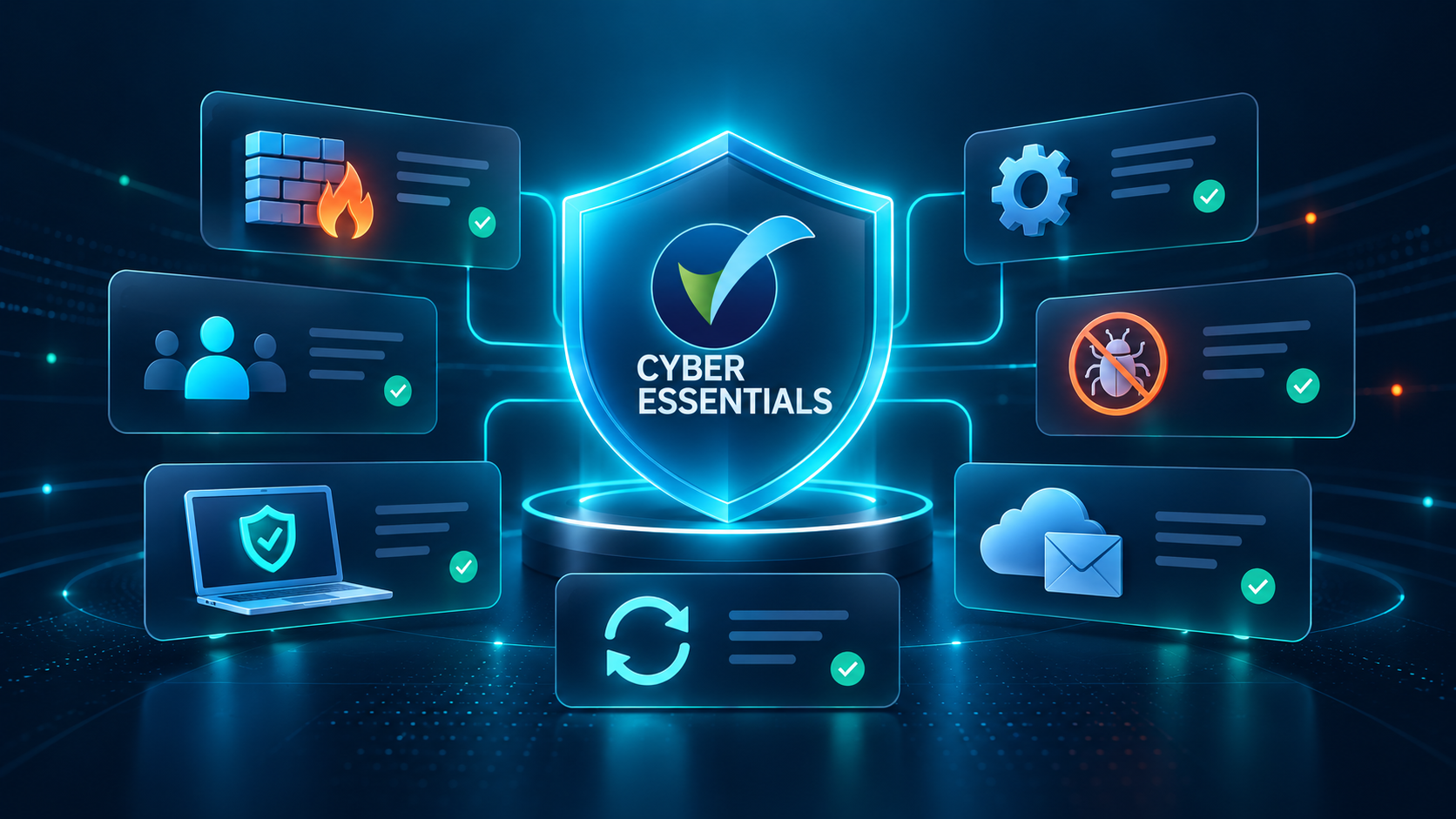
The scheme is built around five technical controls. In plain English, they are:
- Firewalls – protecting the boundary between your systems and the internet.
- Secure configuration – making sure devices, software and services are set up securely rather than simply relying on their default settings.
- Security update management – keeping operating systems, software and devices properly updated so known vulnerabilities can’t easily be exploited.
- User access control – making sure people only have access to the systems and information they genuinely need.
- Malware protection – protecting your devices against viruses, ransomware and other malicious software.
None of those sound particularly dramatic, and that’s the point. A large proportion of cyber attacks look for fairly basic weaknesses: an unpatched piece of software, a badly configured account or a device that isn’t properly protected.
Cyber Essentials is about making those easy routes into your business much harder to find.
Does my Cornwall business need Cyber Essentials?
Cyber Essentials isn’t compulsory for every UK business, but there are plenty of good reasons to consider it.
Some contracts require suppliers to hold Cyber Essentials certification, particularly when working with government or larger organisations with their own supply-chain security requirements. The NCSC also highlights certification as a way to demonstrate to customers that you take cyber security seriously.
Even when nobody is asking you for a certificate, the process itself is useful.
We regularly speak to businesses that have added security measures over time without ever stopping to look at the complete picture. You might have antivirus software, Microsoft 365 security, a firewall and multi-factor authentication, but that doesn’t necessarily mean everything is configured consistently or that every device is properly covered.
Working towards Cyber Essentials gives you a framework for checking.
For growing businesses, it can also be useful preparation for larger tenders, customer security questionnaires and more advanced standards such as ISO 27001.
What has changed with Cyber Essentials in 2026?
Cyber Essentials isn’t a standard you can look at once and forget about. The requirements are reviewed regularly as the way businesses use technology changes.
The current Cyber Essentials technical requirements are version 3.3, which came into effect on 27 April 2026. Among the updates, the requirements now make it explicit that cloud services cannot simply be excluded from the scope of your assessment. The guidance also places greater emphasis on backups and includes an updated definition of passwordless authentication.
The mention of cloud services is important: most Cornwall businesses we work with now use cloud services somewhere in their day-to-day operations, whether that’s Microsoft 365, Google Workspace or another cloud-based platform. Under the current requirements, if your organisation’s data or services are hosted in the cloud, those services need to be considered as part of Cyber Essentials.
You don’t need to become an expert in cloud security terminology. You do need to know what your business uses, who has access to it and who is responsible for securing each part of the service.
What about remote and hybrid workers?
This is another area that can catch businesses out! Your cyber security doesn’t stop at the office door.
The current Cyber Essentials requirements generally include corporate devices and relevant personal devices used for home or remote working. If somebody is accessing company systems from a laptop at home, for example, that device still needs appropriate security controls.
For businesses with staff spread across Cornwall, travelling between sites or working from home, this makes good device management especially important.
It’s worth knowing what devices are accessing your data, whether they’re still receiving security updates and whether accounts can be removed quickly when somebody leaves the business.
The same applies to mobile devices and cloud accounts. An old login that nobody remembered existed can create just as much of a problem as an unsecured laptop.
How difficult is it to get Cyber Essentials certified?
That depends largely on the state of your IT before you start.
If your devices are well managed, software is kept up to date, multi-factor authentication is already in place and you have good control over user accounts, you may already meet many of the requirements.
For other businesses, the assessment can uncover a few jobs that need sorting first. That’s completely normal, and something we can help with.
The important part is identifying those issues before submitting the assessment. Trying to complete the questionnaire without first checking your systems can lead to delays, confusion and unnecessary back-and-forth.
We usually recommend starting with a review of your current IT environment. That means understanding your devices, operating systems, cloud services, user accounts, security tools and network setup, then comparing them with the Cyber Essentials requirements.
Once you know where you stand, the route to certification becomes much clearer.
Common Cyber Essentials problems we see
A lot of the issues that hold businesses back from Cyber Essentials aren’t complicated technical failures – they’re usually small things that have accumulated over time.
A laptop might be running an old operating system; a former employee’s account might still be active. Somebody may have administrator access when they don’t need it. Multi-factor authentication might be switched on for some services but not others.
Growing businesses are particularly prone to this: new starters arrive, new software gets added and people begin working from different places. Before long, an IT setup that was perfectly manageable with five employees looks quite different with 20 or 50.
That’s one reason Cyber Essentials is useful: it creates an opportunity to tidy things up, review your systems and get everything in order.
Is Cyber Essentials the same as good cyber security?
Not quite. Cyber Essentials gives you a strong baseline, but no certification can make a business completely immune from cyber attack.
There are other areas to think about too: backups, staff awareness, phishing protection, email security, monitoring, incident response and disaster recovery, to name a few. In fact, although backups aren’t one of the five Cyber Essentials technical controls, the current NCSC requirements strongly recommend having an appropriate backup solution in place.
We’d always look at Cyber Essentials as part of a wider cyber security strategy rather than the end of the job.
For some organisations, getting the basics right is enough for now. Others may need additional protection such as managed detection and response, vulnerability scanning, advanced email security or a formal information security standard such as ISO 27001.
The right answer depends on your business, the information you hold and the risks you face.
Why use a local Cyber Essentials and cyber security provider in Cornwall?
There are plenty of companies offering cyber security services remotely, but it helps to have an IT partner who can actually come to site.
Piran Tech has been supporting businesses in Cornwall for more than 20 years, with engineers providing both remote and on-site IT support across the county.
Cyber security is a big part of that work.
We’re ISO 27001 accredited, are certified to the Cyber Essentials standards and have also achieved the IASME Governance standard. Those standards sit alongside our wider technology partnerships and accreditations, giving our customers reassurance that we take the security of our own systems seriously as well as theirs.
More importantly, we have practical experience helping businesses work towards certification.
For example, we supported Zapmap with device security, data protection and the controls required for Cyber Essentials, before also supporting the business through ISO 27001 certification.
Our years of practical experience mean that we can offer you expert support when it comes to Cyber Essentials. We’ve encountered all the snags and setbacks, we’ve helped countless customers through the process, we can walk you through it at your pace, and most importantly, make sure that the certification actually helps improve your cyber security position long-term.
How Piran Tech can help with Cyber Essentials
If you’re considering Cyber Essentials but aren’t sure where to start, we can help you review your existing setup and understand what needs to change.
Click here to book a free discovery call to find out how we can help.
That might mean checking whether your software is supported and properly patched, tightening user permissions, reviewing your firewall, securing cloud services, introducing multi-factor authentication or getting better control of company devices.
If there are gaps, we’ll explain them in plain English and help you put them right.
There’s no point recommending an expensive security project when a straightforward configuration change will solve the problem. Equally, if there’s something we find that’s putting your business at risk, we’ll make sure it’s flagged and help you sort it.
That’s the way we approach all of our IT support.
Cyber Essentials FAQs for Cornwall businesses
How long does Cyber Essentials certification last?
Cyber Essentials certification lasts for 12 months, so businesses need to renew annually if they want to maintain current certification.
Do small businesses need Cyber Essentials?
Cyber Essentials is suitable for organisations of all sizes. For small businesses in particular, it provides a manageable framework for improving basic cyber security without requiring a large internal IT or security team.
Is Cyber Essentials required for government contracts?
Cyber Essentials is required for some government contracts, depending on the nature of the work and the information or services involved. It’s also increasingly requested by larger organisations as part of their supplier security requirements.
What's the difference between Cyber Essentials and Cyber Essentials Plus?
Both cover the same five technical controls. Cyber Essentials uses an independently assessed self-assessment, while Cyber Essentials Plus adds hands-on technical testing to confirm that the controls are working in practice.
Can Piran Tech help us get Cyber Essentials certified?
Yes. We can help you understand the Cyber Essentials requirements, review your current systems, identify any gaps and implement the changes needed to get your business ready for assessment.
We can support businesses throughout Cornwall as well as organisations elsewhere in the UK, either remotely or on site.
Get help with Cyber Essentials in Cornwall
Good cyber security doesn’t have to be complicated.
Cyber Essentials gives you a clear starting point, and working through the certification process can help uncover weaknesses before somebody else finds them.
If you’re looking for Cyber Essentials support in Cornwall, or you’d simply like a second opinion on your current cyber security, talk to our team.
We’ll take a look at where you are now, explain what needs attention and help you put practical security measures in place.
Book a free business discovery call, fill out our contact form, or call 01209 340 120 to get started.

We've helped hundreds of businesses protect their systems
Whether you're a small team or a fast-growing corporation, putting a secure cyber security plan in place can feel daunting. We're here to help you make sure all the bases are covered.